主键生成方式
- 若数据库支持自动生成主键的字段(比如 MySQL 和 SQL Server),则可以设置 useGeneratedKeys=”true”,然后再把 keyProperty 设置到目标属性上。
1
2
3
4
5
6
7
8
9
10
11
|
<insert id="insertEmployee" useGeneratedKeys="true"
keyProperty="id">
INSERT INTO t_employee(empname,gender,email)
VALUES(#{empName},#{gender},#{email})
</insert>
|
- 而对于不支持自增型主键的数据库(例如 Oracle),则可以使用 selectKey 子元素:selectKey 元素将会首先运行,id 会被设置,然后插入语句会被调用
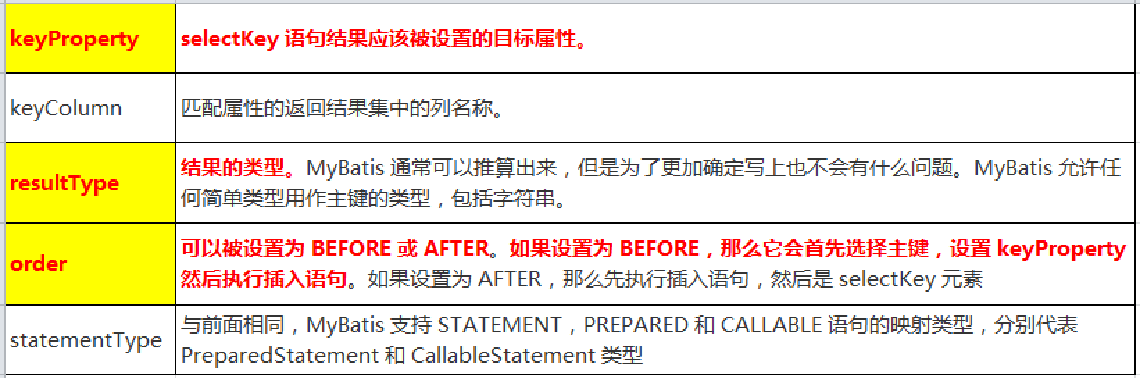
1
2
3
4
5
6
7
8
9
10
11
12
|
<insert id="insertEmployee2">
<selectKey order="BEFORE" resultType="integer" keyProperty="id">
select max(id)+1 from t_employee
</selectKey>
INSERT INTO t_employee(id,empname,gender,email)
VALUES(#{id},#{empName},#{gender},#{email})
</insert>
|
参数(Parameters)传递
- 单个参数
- 可以接受基本类型,对象类型,集合类型的值。这种情况MyBatis可直接使用这个参数,不需要经过任何处理。
- 多个参数
- 任意多个参数,都会被MyBatis重新包装成一个Map传入。Map的key是param1,param2,0,1…,值就是参数的值。
- 命名参数
- 为参数使用@Param起一个名字,MyBatis就会将这些参数封装进map中,key就是我们自己指定的名字
- POJO
- 当这些参数属于我们业务POJO时,我们直接传递POJO
- Map
动态SQL
if
1
2
3
4
5
6
7
8
9
| <select id = findUserByCondition" resultMap="userMap"
select * from user where 1=1
<if test ="userName"!=null">
and username =#{userName}
</if>
<if test ="age"!=null">
and age =#{age}
</if>
</select>
|
where
1
2
3
4
5
6
7
8
9
10
11
| <select id = findUserByCondition" resultMap="userMap"
select * from user
<where>
<if test ="userName"!=null">
and username =#{userName}
</if>
<if test ="age"!=null">
and age =#{age}
</if>
</where>
</select>
|
choose (when, otherwise)
1
2
3
4
5
6
7
8
9
10
11
12
13
14
15
16
17
18
19
20
|
<select id="getTeacherByConditionChoose" resultMap="teacherMap">
select * from t_teacher
<where>
<choose>
<when test="id!=null">
id=#{id}
</when>
<when test="name!=null and !name.equals("")">
teacherName=#{name}
</when>
<when test="birth!=null">
birth_date = #{birth}
</when>
<otherwise>
1=1
</otherwise>
</choose>
</where>
</select>
|
set(解决最后一个,)
1
2
3
4
5
6
7
8
9
10
11
12
13
14
15
16
17
18
19
20
21
22
|
<update id="updateTeacher">
UPDATE t_teacher
<set>
<if test="name!=null and !name.equals("")">
teacherName=#{name},
</if>
<if test="course!=null and !course.equals("")">
class_name=#{course},
</if>
<if test="address!=null and !address.equals("")">
address=#{address},
</if>
<if test="birth!=null">
birth_date=#{birth}
</if>
</set>
<where>
id=#{id}
</where>
</update>
|
foreach
1
2
3
4
5
6
7
8
9
10
11
12
13
14
15
16
17
18
19
20
21
22
23
24
|
<select id="getTeacherByIdIn" resultMap="teacherMap">
SELECT * FROM t_teacher WHERE id IN
<if test="ids.size >0">
<foreach collection="ids" item="id_item" separator="," open="("
close=")">
#{id_item}
</foreach>
</if>
</select>
|
trim
1
2
3
4
5
6
7
8
9
10
11
12
13
14
15
16
17
18
19
20
21
22
23
24
25
26
27
28
29
30
31
32
33
34
35
36
37
38
39
40
41
42
43
44
45
46
47
48
49
|
<select id="getTeacherByCondition" resultMap="teacherMap">
select * from t_teacher
<trim prefix="where" prefixOverrides="and" suffixOverrides="and">
<if test="id!=null">
id > #{id} and
</if>
<if test="name!=null && !name.equals("")">
teacherName like #{_name} and
</if>
<if test="birth!=null">
birth_date < #{birth} and
</if>
</trim>
</select>
|
bind(用处不大)
bind 元素可以从 OGNL 表达式中创建一个变量并将其绑定到上下文。比如:

include
1
2
3
4
5
6
7
8
| <!--抽取可重用的sql语句 -->
<sql id="selectSql">select * from t_teacher</sql>
<!--public Teacher getTeacherById(Integer id); -->
<select id="getTeacherById" resultMap="teacherMap">
<include refid="selectSql"></include>
where id=#{id}
</select>
|